Why Traditional Automation is Failing Businesses in 2026: Moving beyond rigid workflows to build resilient, self-improving business systems.
We stand at a critical juncture in the evolution of enterprise technology. For the past decade, the overarching mandate for CIOs and operations leaders has been “automate everything.” We implemented RPA bots, built complex integration fabrics and scripted every conceivable business process into rigid workflows.
By the standards of 2020, we succeeded. We tore massive amounts of inefficiency out of the system.
But here in January 2026, a new, insidious problem has emerged: The Fragility Trap.
We have discovered that while traditional automation is fast, it is also profoundly brittle. It relies on a stable world—perfect data inputs, unchanging APIs, and predictable customer behaviors. When the real world intrudes with its inherent messiness, these rigid automations shatter. They don’t just stop working; they create silent failures, data corruption, and a massive backlog of manual “exception handling” that consumes the very human resources we intended to free up.
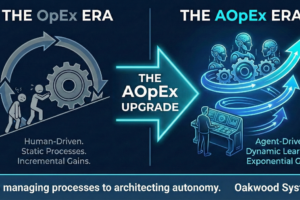
At Oakwood Systems, we believe the era of static, deterministic automation is ending. We are entering the era of Agentic Operational Excellence (AOpEx). This post outlines our framework for transitioning from brittle scripts to resilient, autonomous agents that can reason, adapt, and improve.
The Problem: The Limits of Deterministic Automation
Traditional automation is deterministic. It follows “if/then” logic precisely. If A happens, do B. This works brilliantly for high-volume, low-variance tasks—moving clean rows from a CSV file into a SQL database, for example.
The fundamental flaw is that business is rarely low-variance.
When an API endpoint changes unexpectedly, a deterministic workflow breaks. When a customer email contains sarcasm that a sentiment analysis bot misreads, the workflow fails. When supply chain data arrives in an unrecognized format, the system halts.
In 2026, businesses are finding that they have traded manual labor for “bot maintenance.” We are spending too much time babysitting our automations. We have built faster juggernauts, but they still require a human driver to steer around every pothole.
If your systems require human intervention every time variables shift, you have not achieved operational excellence. You have merely accelerated mediocrity.
Defining Agentic Operational Excellence (AOpEx)
Agentic Operational Excellence (AOpEx) is the strategic framework of deploying AI-driven systems designed not just to execute tasks, but to achieve objectives.
The core distinction is Agency.
A traditional workflow has no agency; it is a passive executor of instructions. An agentic system possesses a degree of autonomy within defined guardrails. It can perceive its environment (context), reason about the best path to a goal, act on that reasoning, and learn from the outcome.
Moving to AOpEx means shifting our focus from programming the steps to programming the goals and the boundaries.
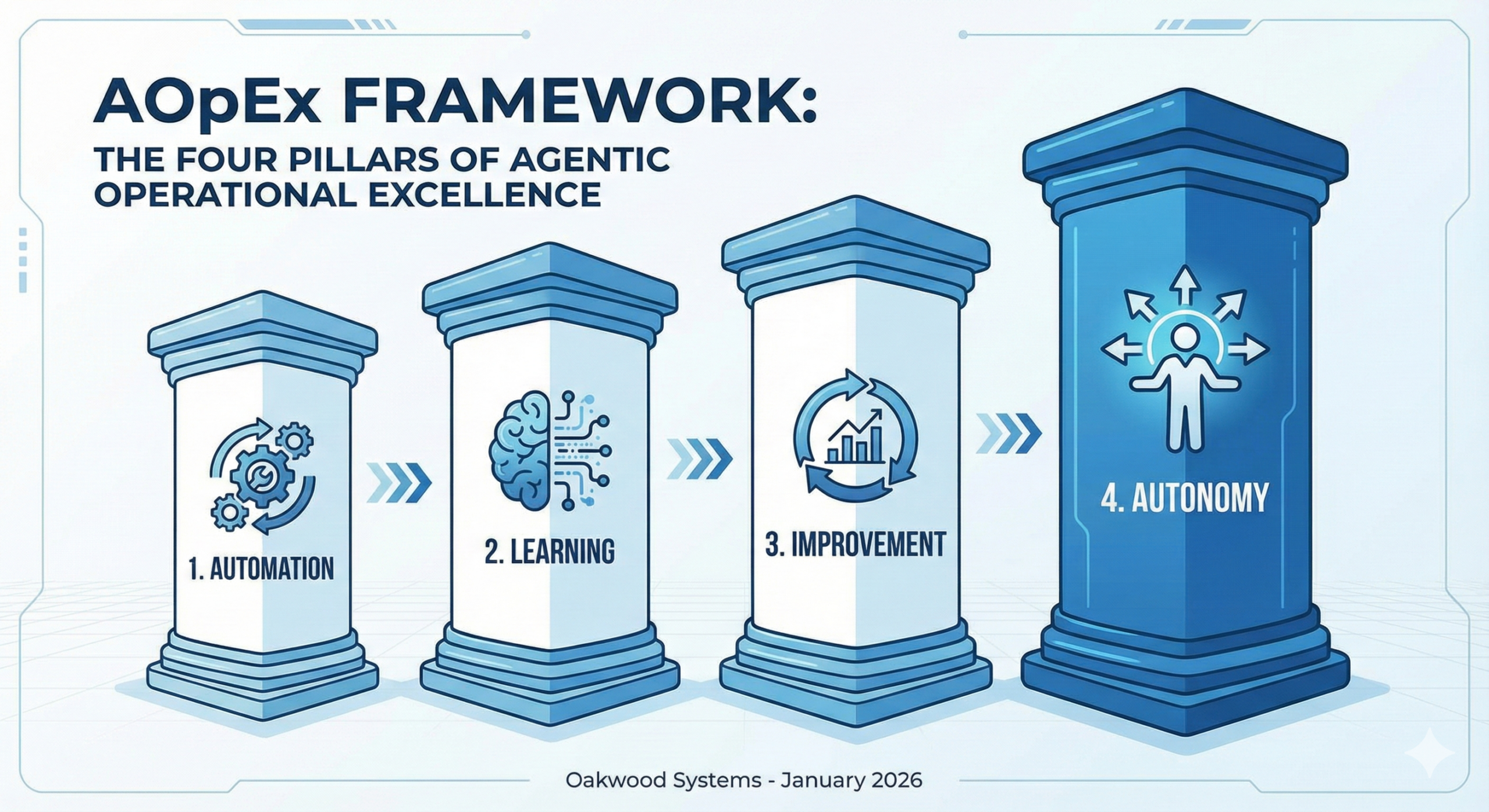
The AOpEx Framework: The Four Pillars
At Oakwood Systems, we have developed a maturity model for AOpEx comprised of four distinct pillars. Organizations must fortify each pillar to move from fragile automation to resilient autonomy.
Pillar 1: Automation (The Foundation)
We cannot skip the basics. Pillar 1 is the plumbing of the modern enterprise. It involves the robust connection of disparate systems via APIs, webhooks, and event buses.
In an AOpEx framework, however, automation is built differently. It is modular and decoupled. We use tools like n8n not just to create monolithic 50-step workflows, but to create smaller, composable “skills” that an agent can call upon.
Current State (2026): Most organizations are mature here, but their implementations are often too rigid.
AOpEx Goal: Convert monolithic scripts into a library of composable actions (e.g., “Update CRM record,” “Generate Invoice,” “Slack Alert Team”).
Pillar 2: Learning (Contextual Awareness)
A script only knows its inputs. An agent must know its context. Pillar 2 is about giving systems memory and understanding.
This involves integrating Vector Databases (RAG – Retrieval-Augmented Generation) and Large Language Models into the operational flow. When an invoice arrives, the system shouldn’t just extract the total; it should “remember” that this specific vendor frequently overcharges on shipping and flag it based on historical context.
Learning transforms data into situational awareness. It allows the system to handle “fuzzy” inputs that would break a traditional bot.
AOpEx Goal: Give operational systems access to organizational knowledge bases and historical performance data to inform real-time processing.
Pillar 3: Improvement (Self-Optimization)
This is where the ROI begins to compound exponentially. In the old world, when a workflow broke, it sent an error log to an IT ticket queue. A human had to diagnose the break, rewrite the code, test it, and redeploy it.
In the AOpEx framework, the system is designed to identify bottlenecks and failures and, crucially, suggest or implement fixes.
If an agent notices that Step 4 of a process fails 30% of the time due to API timeouts, it shouldn’t just report the errors. It should suggest implementing an exponential backoff retry mechanism or switching to an alternative data source. Improvement becomes part of the system’s loop, not an external human activity.
AOpEx Goal: Close the feedback loop. Systems must monitor their own performance criteria and actively seek ways to optimize throughput and reduce error rates.
Pillar 4: Autonomy (Goal-Directed Action)
Autonomy is the apex of the framework. It is the shift from “executing tasks” to “pursuing goals.”
An autonomous agent is given an objective: “Ensure customer issue #9921 is resolved satisfactorily and update all relevant systems.”
The agent then determines the necessary steps. It might need to query the shipping database, draft a personalized email using the LLM, process a partial refund via Stripe, and update Salesforce. It calls upon the “skills” built in Pillar 1, uses the context from Pillar 2, and learns from the outcome in Pillar 3.
Crucially, autonomy operates within strict human-defined guardrails (e.g., “You cannot authorize refunds over $500 without human approval”).
AOpEx Goal: Resilient systems that can navigate ambiguity to achieve business outcomes without constant human hand-holding.
The Path Forward
The transition to Agentic Operational Excellence is not a “rip and replace” strategy. It is an evolutionary layering process.
At Oakwood Systems, we are helping clients audit their existing brittle automations and identify high-value targets for converting to agentic workflows. We are building the infrastructure—the vector databases, the LLM guardrails, the composable workflow libraries—that makes AOpEx possible.
In 2026, competitive advantage will not belong to the company with the fastest automation. It will belong to the company with the most resilient, adaptable, and intelligent systems. It’s time to stop building fragile bots and start building capable agents.