Let’s be honest about the state of operations today.
For decades, we’ve relied on Lean and Six Sigma. We’ve mapped value streams, hunted down waste, and trained our people to be the guardians of efficiency. It worked. It got us here.
But the playbook is outdated.
We are trying to apply manual, human-speed management techniques to a digital, light-speed world. We have access to incredible tools—AI agents, advanced orchestration platforms like n8n, and massive data streams—but we’re still managing them like we manage a factory floor from 1990.
The bottleneck isn’t the technology. The bottleneck is the methodology.
We don’t need another Kaizen event. We need an entirely new operating system for how work gets done. That is why I developed Agentic Operational Excellence (AOpEx).
The Friction: The Efficiency Trap
The fundamental flaw in traditional OpEx is the assumption that a process is static until a human decides to fix it.
We follow the Plan-Do-Check-Act (PDCA) cycle. It’s effective, but it’s slow. It introduces “cognition latency”—the time it takes for a human to notice a problem, analyze the data, and implement a fix.
In 2026, data moves too fast for that.
When you layer modern automation on top of old processes without rethinking the underlying system, you get “Fragile Automation.” You get scripts that break the moment an API changes. You get AI that requires constant babysitting. You end up working for the robots, instead of the other way around.
The Upgrade: Agentic Operational Excellence (AOpEx)
AOpEx is what happens when you apply Systems Engineering rigor to AI automation.
The goal shifts:
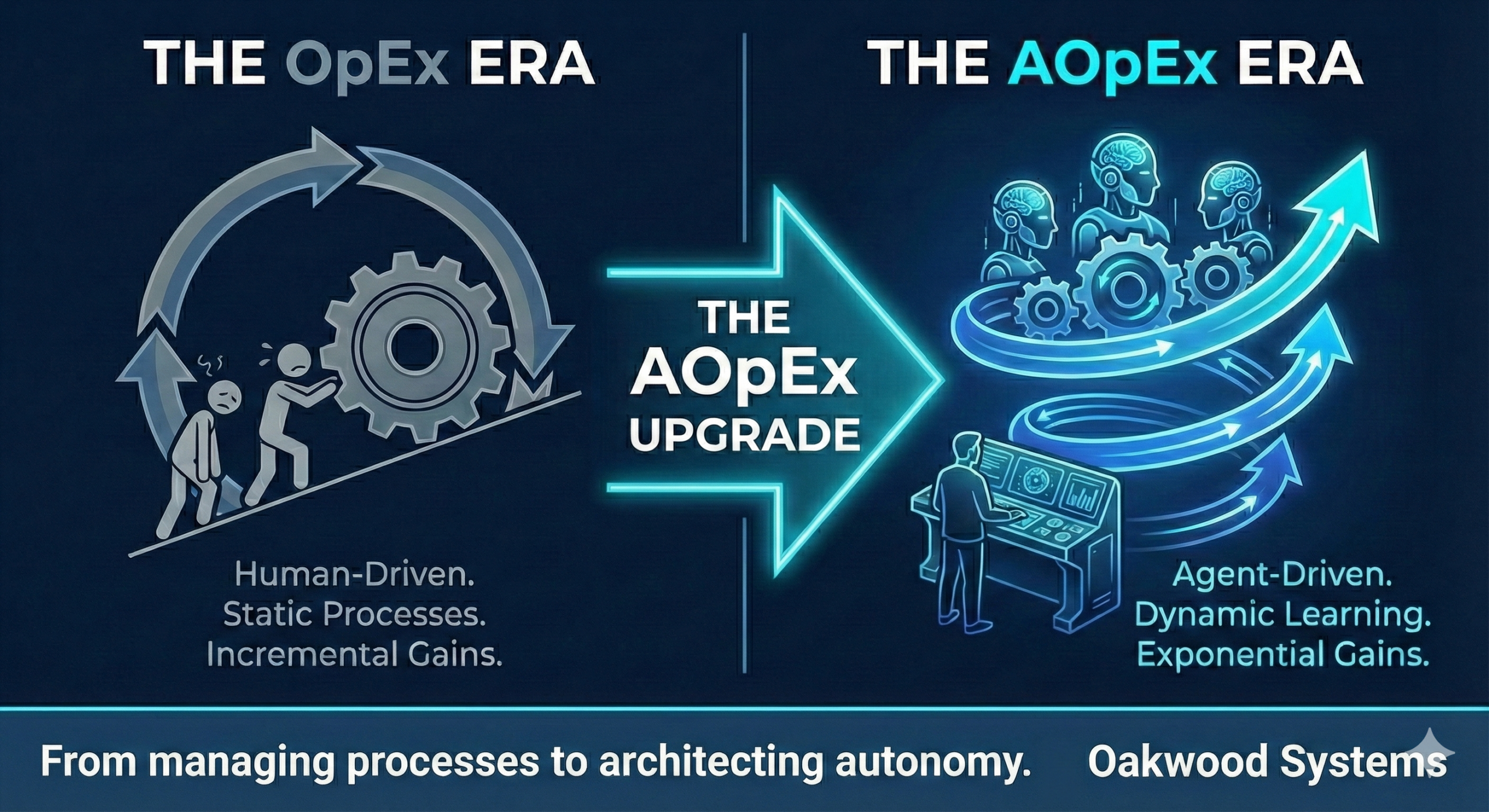
- Old Way (OpEx): Continuous Improvement (Humans incrementally fixing processes).
- New Way (AOpEx): Autonomous Improvement (Systems identifying and resolving their own friction).
This isn’t about removing humans. It’s about elevating them. In an AOpEx environment, you stop being an Operator who turns the crank, and you become an Architect who designs the machine. You define the intent, the guardrails, and the goals—the agents handle the execution.
The Framework: Four Pillars
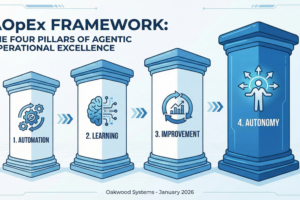
I view AOpEx through four distinct pillars. This isn’t just theory; this is how we build workflows at Oakwood Systems.
Pillar 1: Automation
This is where we move beyond simple “If This Then That” scripts. We’re talking about intelligent orchestration.
- The Shift: Using tools like n8n to build event-driven workflows that can handle non-linear logic.
- The Goal: Resilience. We build systems that can handle errors, retry failed steps, and route around obstacles without crashing.
Pillar 2: Learning
A system that doesn’t remember is doomed to repeat its mistakes.
- The Shift: Traditional lessons learned live in PowerPoint decks. AOpEx systems maintain their own state and memory. They log why a decision was made, not just what happened.
- The Goal: Observability. I want to look at a dashboard and see exactly how the system is “thinking.”
Pillar 3: Improvement/Optimization
This is the speed of adaptation.
- The Shift: Moving from quarterly reviews to real-time optimization. If an agent detects a bottleneck, it flags it instantly.
- The Goal: Agility. The time between “error detection” and “mitigation” should be near zero.
Pillar 4: Autonomy
This is the North Star.
- The Shift: Agents that aren’t just following rules, but pursuing goals. (e.g., “Process this invoice, but if the vendor is new, verify them first, then proceed.”)
- The Goal: Alignment. Agents operating independently, but strictly within the strategic and ethical guardrails we define as Architects.
The Methodology: Systems Engineering, Not Just Coding
At Oakwood Systems, we don’t just “write code.” We engineer solutions. There is a difference.
Implementing AOpEx requires a disciplined lifecycle:
- Requirements: What is the strategic intent?
- Architecture: How do the humans, the agents, and the software stack fit together?
- Orchestration: Building the connective tissue (usually via n8n) that makes the system flow.
- Validation: rigorous testing to ensure the agents stay within their lanes.
This approach ensures the systems we build are deterministic where they need to be, and creative where we allow them to be.
Conclusion
The future belongs to the Architects.
The companies that win in the next decade won’t be the ones working the hardest. They will be the ones with the smartest, most autonomous systems.
AOpEx is the blueprint for that transition. It’s the path away from the grind of manual management and toward a future where your business is a living, learning system.
Let’s build it.